
A career change from teacher to nurse can be rewarding, with higher earning potential and more flexibility. Many skills transfer between these careers. The transition from teaching to nursing can also be completed in as few as 16 months through Madonna University’s ABSN program.
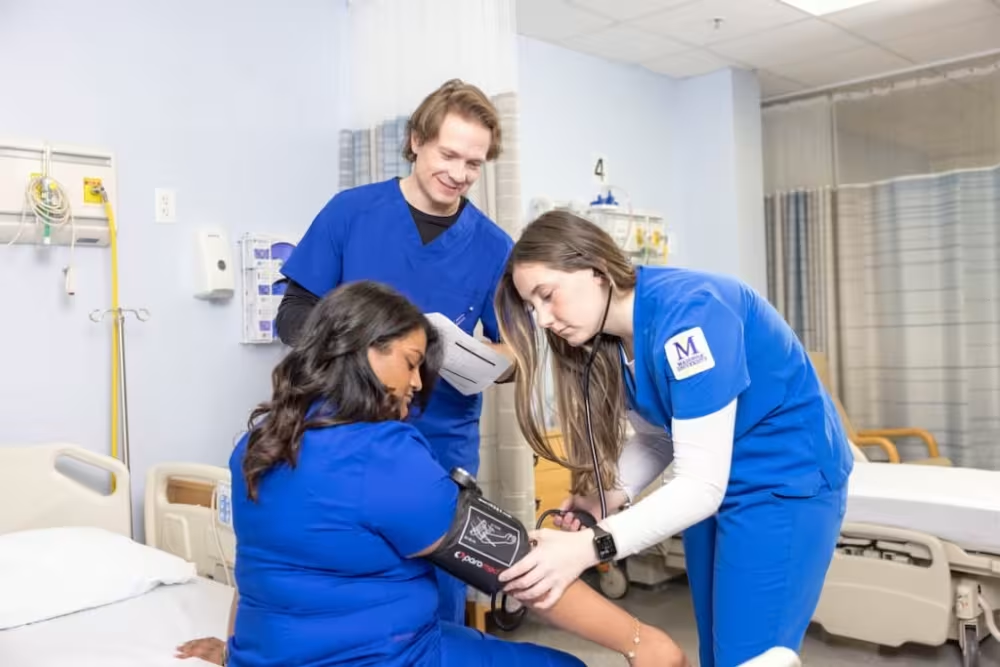
Are you considering a career switch from teacher to nurse? Many start out in teaching to help children but eventually seek a new career that is still oriented toward helping others. Making a career change from teaching to nursing can be accomplished by pursuing a nursing degree in an accelerated program.
At Madonna University, individuals with a previous non-nursing bachelor’s degree or at least 60 college credits can apply to our Accelerated Bachelor of Science in Nursing (ABSN) program to earn a BSN in as few as 16 months. This program will equip you with the foundational knowledge and skills to succeed in the nursing field through a nursing curriculum of hybrid coursework, skills and simulation labs, and clinical rotations.
Explore why you should consider nursing, the benefits of doing so, and the skills that can transfer from teaching.
Why Pursue a Career in Nursing After Teaching?
Although changing careers from teaching to nursing may seem intimidating, there are many benefits to making this move. In nursing, you will earn a competitive wage, have schedule flexibility, and enjoy advancement opportunities.
A career in nursing lets you apply skills you have developed during your teaching career in a different way. With increasing demand nationwide, nursing is a great career choice. It may seem daunting, but earning your nursing degree as a second degree can be an accessible and streamlined process.
Nursing vs Teaching
If you are thinking about making the career change from teacher to nurse, you may want to know about the differences between a teaching and nursing career. Depending on location, job opportunities and seniority, both teachers and nurses can earn competitive salaries. High-paying teaching positions are far less common than in nursing, with the U.S. Bureau of Labor Statistics (BLS) reporting that only New York and Rhode Island teachers earn an annual mean wage higher than the nationwide nursing mean wage of $93,600.
Both can enjoy scheduling flexibility and advancement opportunities, though the form of each can vary depending on career field. The benefits of each depend on the level of education, position, and years of service.
Learn more about why nursing is a great career at any age.
Salary Comparison
According to the BLS, the median annual wage for K-12 teachers ranged from $62,310 to $64,580 in 2024. High teacher salaries typically require many years of experience at a given institution. Comparatively, the BLS reported a median annual salary for nurses of $93,600 in 2024. Employment for registered nurses is expected to grow by 5% from 2024 to 2034.
As a nurse, you could see an even higher salary after gaining experience, earning an advanced degree, or specializing in a complex field.
Flexibility
Many nursing roles feature scheduling flexibility. Shifts vary depending on the setting. Hospital nurses, for example, might work three 12-hour shifts per week, while nurses in other practice settings might work a higher number of eight or 10-hour shifts. Nursing allows you to find a weekly schedule that works for you.
Nurses and teachers can both work on a part-time as needed basis. Teachers have a less flexible weekly routine but are often unscheduled during academic breaks, leaving more time for other pursuits.
Advancement Opportunities
As a nurse, you can pursue advancement opportunities that may lead to higher salaries, improved job satisfaction, and increased nursing skills.
By pursuing an advanced practice degree, such as a Master of Science in Nursing (MSN) or a Doctor of Nursing Practice (DNP) at Madonna University, you can gain quality education and skills while securing access to higher-paid advanced practice roles.
You might also pursue a specialization in a specific field, like oncology or critical care. By earning a certificate in these areas, you will enhance your knowledge, advance your expertise, and potentially increase your salary.

What Skills Will Transfer From Teaching to Nursing?
If you are seeking a new career where you can use your current skill set or continue making a positive impact on society, nursing is an excellent choice. Even though you will learn many new skills, your current skill set will greatly assist you as an ABSN student and in the nursing workforce.
Making an Impact
If you still want to make an impact on people’s lives but want to leave the teaching field, you can still make a life-changing impact by pursuing nursing. As a nurse, you will deliver medical care and emotional or physical comfort to patients experiencing distress or trauma. Through your work as a nurse, you can change an individual’s life for the better.
Soft Skills
As a teacher, you have likely developed strong patience, compassion, and empathy for others through your work with parents, children, or schools. As a nurse, you will need these skills as you interact with distressed patients, with other doctors and nurses, or in busy hospitals.
You have also likely developed strong critical thinking and problem-solving skills. As a teacher, you have already learned to analyze situations and make wise decisions while finding new avenues to solve problems. As a nurse, you will need to find creative solutions to problems and quickly make the best decisions in fast-paced situations.
As a teacher, you already have strong time management and organizational skills from lesson planning and managing a classroom full of students. Since these are necessary skills for individuals pursuing a nursing degree, especially in an ABSN program, you will be well prepared for success when studying for your BSN.
Teachers must pay close attention to detail and be flexible when differentiating the educational needs of each student or taking on tasks beyond teaching like grading papers, progress monitoring, assessing, and documenting. From your teaching experience, you may already have these two essential nursing soft skills. Nurses must be adaptable in the often-unpredictable environment of a hospital and pay close attention to all details around them. As a Madonna ABSN student, you will apply this skill during clinical rotations, treating real patients under supervision across various practice areas.
Hard Skills
A few hard skills you have practiced as a teacher will transfer well to the nursing workforce.
Even though you will not be teaching in a traditional setting, as a nurse, you will educate patients about their conditions, medications, and care needs. You will use the communication skills of an educator to translate complex knowledge and information so families and patients can understand.
You have also learned how to correctly document and track incidents, grades, and the progress of many students as a teacher. This skill also transfers, as a nurse must correctly document and maintain patients’ charts or health records.
How to Change Careers from Teaching to Nursing?
The transition from teacher to nurse can be made quickly through an ABSN program. Using your previous bachelor’s degree, you can apply to an ABSN program like Madonna’s to earn your nursing degree. You will not need to return to college for another four years because ABSN students at Madonna University can earn their nursing degrees in as few as 16 months.
Before completing the ABSN program, you may need to finish a few prerequisite courses to prepare you for the accelerated curriculum. After you earn your nursing degree, you must then take and pass the NCLEX-RN, a thorough licensing exam to ensure you have all the necessary knowledge and skills to be a nurse.
Once you have your nursing degree and RN license, you can start working at a hospital and making a positive impact on your patients.

Learn more about the prerequisites of nursing and why they matter.
Pursue a Nursing Degree at Madonna University
If you are ready to take the first step to change careers from teacher to nurse, consider Madonna University’s ABSN program. Through the ABSN program, you can put previous skills from your teaching career into practice while learning more knowledge and skills to become a competent nurse.
Contact us to learn how Madonna University’s accelerated nursing program can help you make your transition from teacher to nurse. Madonna University is accredited by the Higher Learning Commission (HLC). The Bachelor of Science in Nursing program is approved by the Michigan Board of Nursing.